What I build with AI
I design products for a living. At home I build my own with Claude, for the small parts of my day I don't like doing. This page lists what I use, how each one is built and the one I stopped looking after.
I don't come from engineering. I'm also not able to get rid of Claude, because it gives me the illusion of things getting done. The click for me was the ability to do.
I try to stay attached to my own flow and use it for the tiny parts I don't like doing. In the end it's about how invisible the stuff can be while giving me the best output. No device is the best device.
Non-Annoying TV
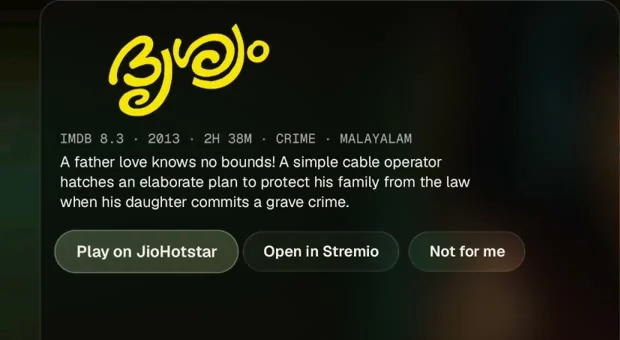
It is a home screen for Google TV. I hated going to IMDb for good stuff every single time, then finding our subscriptions didn't have it or it wasn't available in the country. With Claude I took over our TV and took the ads off it. I designed the home in Figma and Claude built it as an Android TV app.
Now we say what we feel like watching in our own words, and Hinglish works. Claude finds real titles with the IMDb rating on the card, and one press opens a film in an app we already pay for.
Half the work got done while I had coffee with my wife. It has been tested on one TV, ours. The code is public on GitHub and there is a short film of it on X.
A gym plan that rewrites itself
I have been working out for almost 12 years and I used to hate logging. Stopping between sets to write things down never stuck. Now I just talk, and my plan updates every day from what I say. A page on my phone shows that day's session, so when I get to the gym I open it and the workout is already there. The daily updates just happen. Changes to the plan itself wait for my OK.
A recorder that sorts its own notes
I wear a note taker that hears my day. I wanted one thing absorbing all of it and feeding the tools I build for my personal life, so I don't have to repeat context. An agent takes what it hears and bifurcates it into buckets. Work goes to work, personal goes to personal. My other tools each read their own bucket: the TV gets the films that came up. It all stays private, and I decide what any of my tools gets to see.
Passive Mind
Early in 2026 I had this idea. There is so much context that happens around me, and I wished there was a way to capture it. I made a passive recording thing for my phone and my laptop and attached it to an Obsidian kind of interface that could auto-link. Claude reads each capture and writes wiki pages for the people and projects in it. I pulled in years of my old chats to see if it could become my second brain. By April it had written a few thousand pages. Then I got busy with other things and left it there. It's more about acting on your thoughts than thinking of things. I didn't act enough on it.
reelkit
I make reels, and I didn't want to explain my style from scratch on each one. reelkit is one command. I give it raw clips and a voiceover, and finished reels come back in my own edit and caption style. It knows my captions, down to the yellow hero words that sit behind people. My voice is left at its own pace. After each project it writes down what I approved and what cost us rounds, so the next reel doesn't start from scratch. I still shoot the people and do the grade myself, and it doesn't land first time. The TV reel took nine versions. It is a Claude Code skill sitting on Python scripts, with Figma for the frames I design myself.
A design team that ships production PRs
At Zero I set up Design & Experience and built a 12-person multidisciplinary team. Our designers prototyped in code and shipped production PRs. That is what AI-native meant inside the team.
I advise founders as a fractional design lead and take on select brand, website and product projects for consumer and AI startups.